PORTFOLIO

Security Engineering& Technical Leadership

Technical Leadership · AI & Agent Security · Product Security · Cloud IAM

I build security controls, coordinate cross-functional project work, and turn technical risk into engineering and business decisions. My work spans AI-agent security, cloud identity, threat detection, and team delivery.

Agent → Tool782 Python 3.12 CI tests · default-deny execution controls
Identity → Authority25 IAM rules · privilege and trust-policy analysis
Artifact → Runtime33/33 adversarial fixtures · non-executing inspection
Telemetry → Investigation212 local Milestone C tests · incident workflow (unmerged)
Repository-backed evidence with CI verification and explicit scope limitations.
Pooja Kiran
“AI becomes a different security problem when it can act.”— Pooja Kiran

For recruiters & hiring teams

Explore My Experience

One background, two ways to evaluate it. Choose the resume most relevant to the role you're hiring for. My projects and full experience are available to everyone below.

Build & Secure

Security Engineering

For roles focused on designing, implementing, and validating security controls across AI agents, applications, cloud identity, and detection systems.

  • MCP gateway with 782 passing CI tests
  • 25-rule AWS IAM static analyzer
  • AI model supply-chain and detection tooling
View Security Engineering Resume
Lead & Deliver

Engineering Leadership

For security-focused engineering management and technical leadership roles emphasizing team coordination, deliverable reviews, stakeholder communication, and business planning.

  • Coordinated work within a four-member AEROSEC team
  • Reviewed remote peer deliverables and reported to mentors
  • Presented a proposed $120,000 first-year budget and security plan
View Engineering Manager Resume

Both resumes reflect the same experience, tailored to different hiring priorities.

Leadership highlights

Coordinating people, technical work, and business decisions.

03

Remote peer leads

Assigned responsibilities and reviewed deliverables during designated AEROSEC lab phases within a four-member team.

03

Industry pitches

Presented aviation security risks, market positioning, and financial assumptions to Honeywell evaluators.

$120K

Proposed first-year budget

Developed a 12-month operating plan and compared four commercial security solutions; figures were proposals, not realized funding.

Read the full experience

Four security trust boundaries

Agent → Tool. Identity → Authority. Artifact → Runtime. Telemetry → Investigation.

Selected build 01

MCP Agent Security Gateway

Agent tool calls cross an execution boundary where authorization, content risk, egress policy, rate limits, and audit evidence need to be enforced before downstream execution.

PythonFastAPIMCP/JSON-RPC 2.0Elastic Security

Project work: Oct 2025 to Oct 2026. CI figures are from a specific October 2026 Python 3.12 run, not operational detection effectiveness.

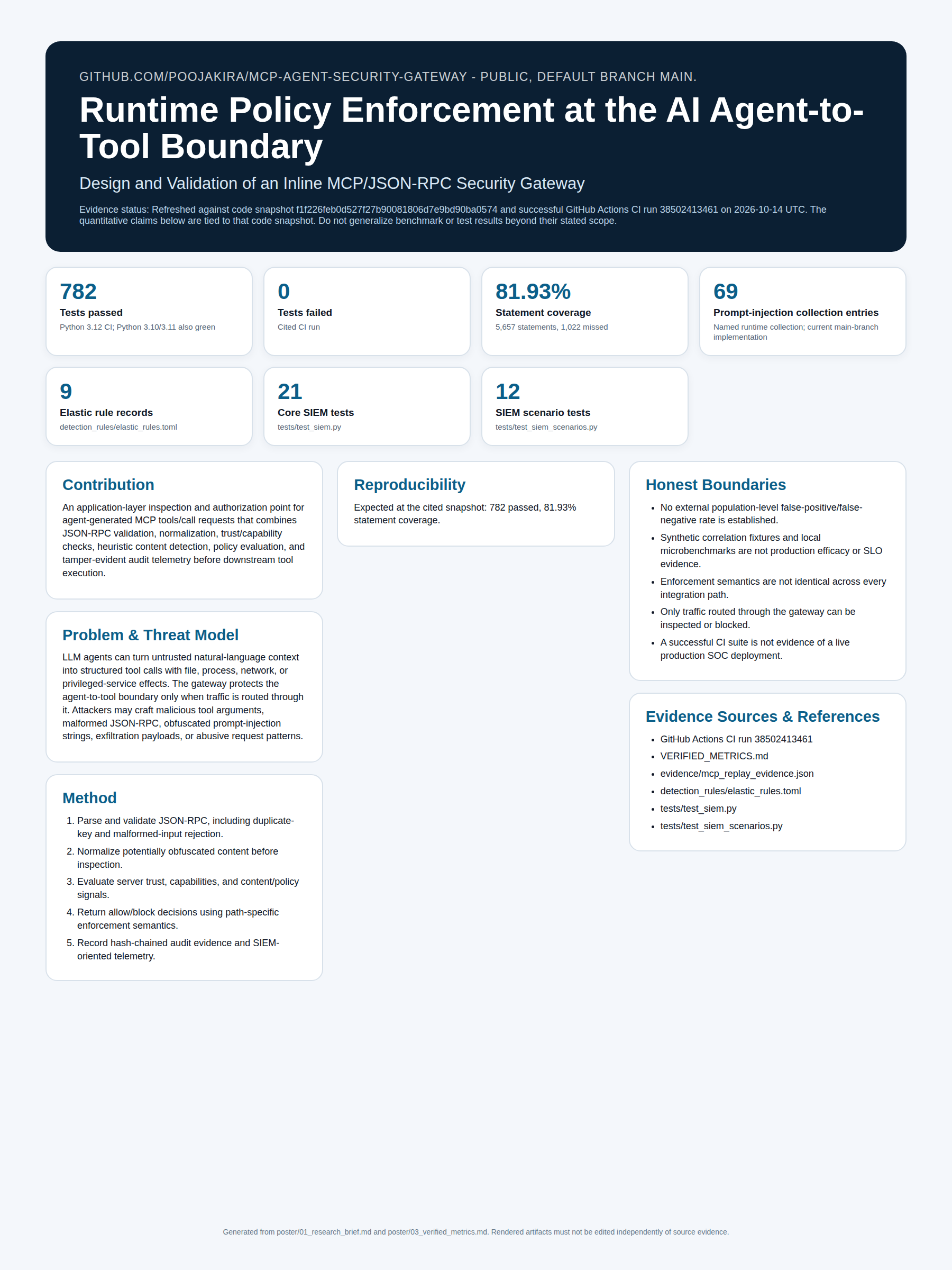
MCP Agent Security Gateway evidence poster
Current verified evidence poster · repository-backed
Security outcome

What the control protects and how it is verified

  • Engineered a default-deny agent-to-tool gateway with capability checks, request inspection, anti-SSRF egress rules, and rate limits.
  • Implemented 69 named prompt-injection signatures, PII/exfiltration signals, hash-chained auditing, and nine Elastic Security rule records.
  • Built automated regression coverage for gateway controls and SIEM integration; the Python 3.12 suite passed 782 tests with 81.93% statement coverage.
Architecture & verification

How the security decision is enforced end to end

01Agent tool call
02Capability authorization
03PII and exfiltration checks
04Anti-SSRF and rate limits
05Fail-closed enforcement
06Audit and telemetry
782 tests in cited Python 3.12 CI81.93% coverage, same CI run69 prompt-injection patterns9 Elastic rules21 core SIEM tests
Evidence boundary

The evidence supports implemented controls and bounded test results. It does not claim customer deployment, enterprise adoption, or universal prevention.

Selected build 02

AWS Agent Identity Guard

Agent and workload identities can become over-privileged through wildcard grants, iam:PassRole, sts:AssumeRole, weak trust policies, privilege-escalation paths, and missing permission boundaries.

PythonAWS IAMSARIF 2.1.0

Project work: Apr 2025 to Oct 2026. Static policy analysis does not establish live AWS authorization outcomes.

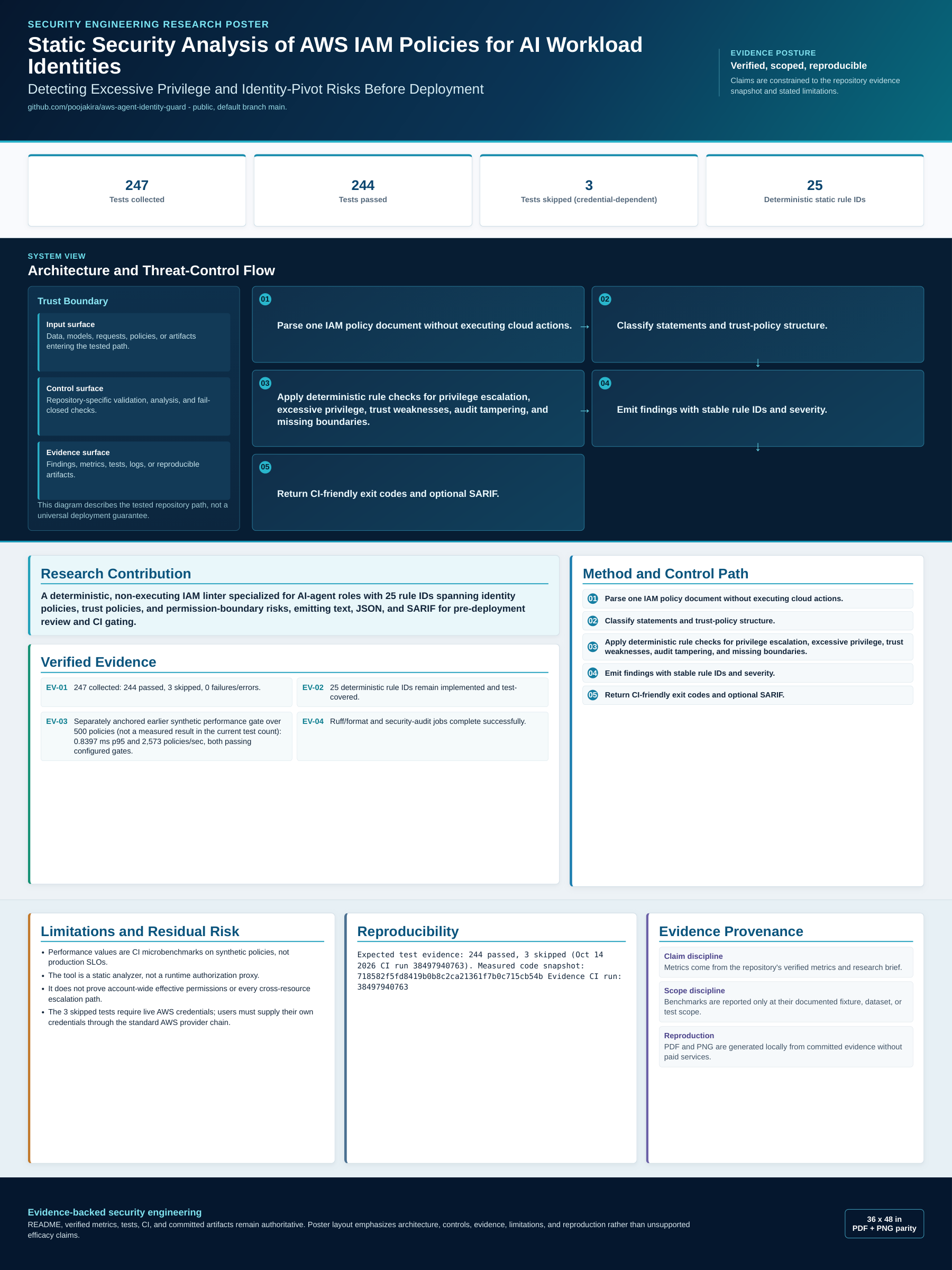
AWS Agent Identity Guard evidence poster
Current verified evidence poster · repository-backed
Security outcome

What the control protects and how it is verified

  • Built a static workload-identity analyzer for dangerous grants, escalation paths, trust-policy weaknesses, and missing permission boundaries.
  • Implemented 25 deterministic rules for wildcard access, iam:PassRole, sts:AssumeRole, and trust policies; emitted CI-readable SARIF findings.
  • Tested IAM policy analysis through CI, with 244 passing tests; three live-AWS checks were skipped because they required credentials.
Architecture & verification

How the security decision is enforced end to end

01IAM policy
0225 deterministic rules
03Finding evidence
04Text / JSON / SARIF
05GitHub Code Scanning
06Code review
25 deterministic rules244 passed / 3 skippedSARIF 2.1.0GitHub Code Scanning
Evidence boundary

The evidence supports deterministic static-policy analysis. It does not claim complete effective-permission evaluation, production latency, or runtime authorization guarantees.

Selected build 03

HF Model Provenance Scanner

Untrusted model repositories and artifacts can carry serialization, loader, dependency, provenance, and obfuscation risk before a model is loaded.

PythonSafeTensorsGGUFONNXKeras

Project work: Nov 2024 to Oct 2026. Committed regression fixtures are bounded tests, not population-level malware detection evidence.

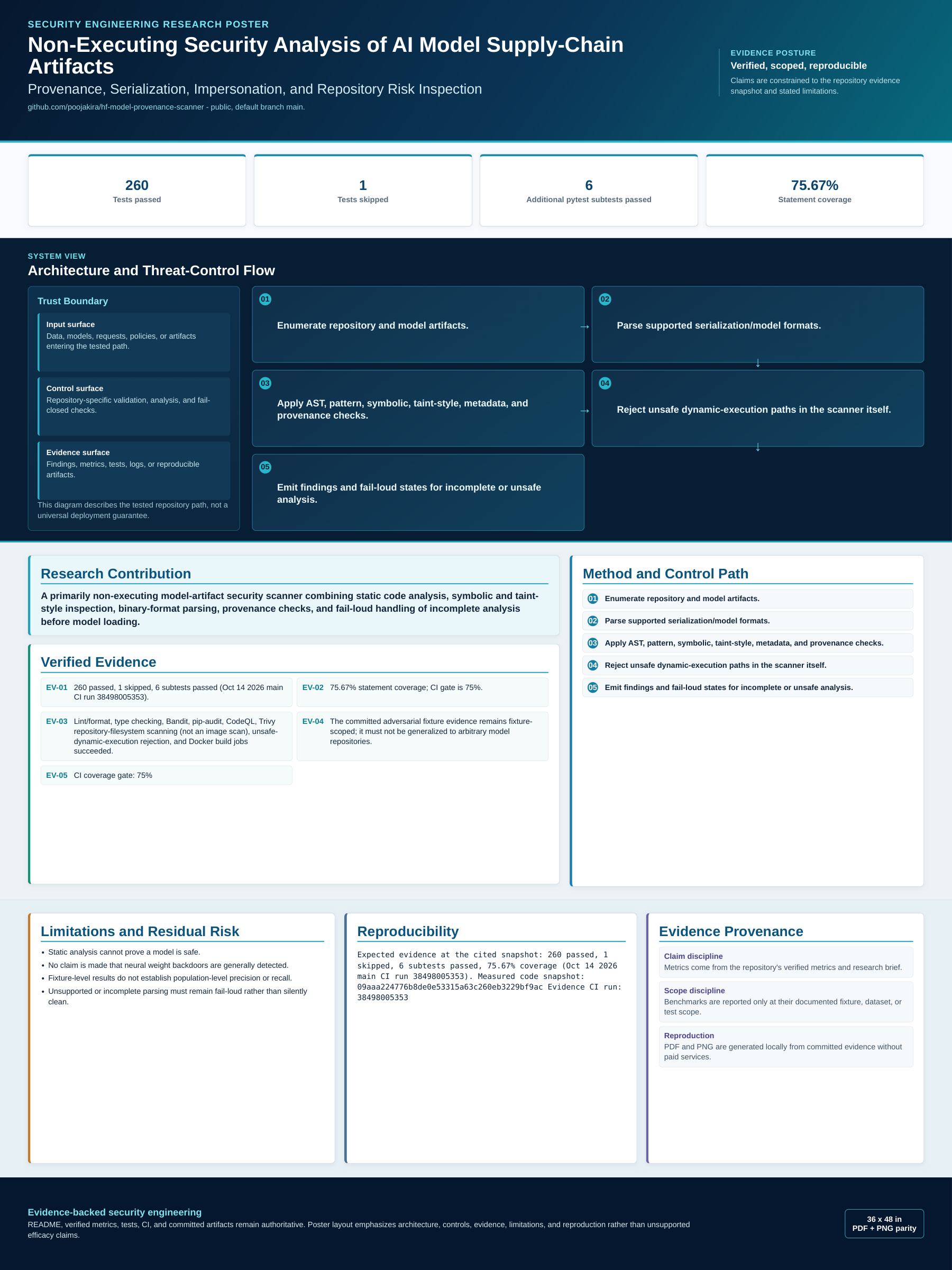
HF Model Provenance Scanner evidence poster
Current verified evidence poster · repository-backed
Security outcome

What the control protects and how it is verified

  • Built non-executing model artifact scanning for pickle-derived, SafeTensors, GGUF, ONNX, and Keras formats.
  • Combined serialization, AST/taint, provenance, and dependency checks; flagged 33 of 33 committed adversarial test fixtures.
  • Tested model artifact inspection in CI: 260 tests passed with 75.67% statement coverage.
Architecture & verification

How the security decision is enforced end to end

01Repository or artifact
02Non-executing inspection
03Pickle and AST/taint checks
04Dependency and provenance checks
05Obfuscation and format checks
06Findings
260 passed / 1 skipped75.67% coverage33/33 committed adversarial fixtures0 actionable / 4 committed benign samplesNon-executing inspection
Evidence boundary

The fixture results are bounded regression evidence; the benign result covers only four committed samples. Neither is a universal detection or false-positive rate.

Selected build 04

Attack Detection Engine | Aegis HealthSec

Security teams need more than isolated alerts: related events must become explainable, durable incidents that authorized analysts can investigate and resolve.

PythonFastAPIPostgreSQLReact / TypeScriptDockerMITRE ATT&CK v19

Initial ARM/CAN work was verified on main in October 2026 (68 local tests); the newer investigation and security-hardening evidence belongs to separate, unmerged October 27 development branches.

Engineering evidence illustration · not a live SOC
Security outcome

What the control protects and how it is verified

  • Built offline automotive CAN/CAN-FD and firmware/ARM ELF32 lab analysis alongside the existing ATT&CK-oriented detection pipeline.
  • Added clinical-access detection on a development branch; MIMIC-IV Demo supplies de-identified clinical context, while all access events are synthetic.
  • Developed an authenticated investigation workflow that ingests events, correlates findings, persists incidents, and records analyst resolution and audit actions; demonstrated using real PostgreSQL and Docker in controlled tests.
Architecture & verification

How the security decision is enforced end to end

01Synthetic clinical access telemetry
02Normalize and validate
03Rule-based detection
04Evidence-based correlation
05PostgreSQL incident record
06Authenticated analyst review and audit
212 local tests: Milestone C, Oct 27 2026280 local tests reported: Milestone DHosted CI blocked; PRs unmergedFHIR R4 AuditEvent connector: PR #50 (unmerged) · 296 local tests reported
Evidence boundary

The investigation platform and hardening are currently on unmerged development branches. Healthcare events and incidents in the demonstration are synthetic; MIMIC-IV Demo does not supply audit logs or access authorization. FHIR R4 AuditEvent ingestion is published for review in unmerged PR #50, with 296 local tests reported for Milestone E; hosted CI remains blocked and live hospital ingestion is not claimed. No hospital deployment, HIPAA certification, production readiness, or real-world detection-rate claim.

Engineering case study · development branches

From telemetry to a defensible investigation.

Attack Detection Engine / Aegis HealthSec extends the original ATT&CK and automotive lab engine with a healthcare-focused, deterministic incident investigation workflow. This is a source-backed illustration of locally tested work, not a live SOC connection.

01 · Ingest

Synthetic clinical access events enter the authenticated FastAPI service. FHIR R4 AuditEvent adapter is available for source review in unmerged PR #50; test events are synthetic.

02 · Detect

Existing deterministic clinical-access rules generate explainable findings; benign-control scenarios are checked.

03 · Correlate

Related findings group by documented identity, organization, resource and time criteria rather than coincidental event proximity.

04 · Persist

PostgreSQL retains events, findings, incidents and their relationships through controlled container restarts.

05 · Investigate

Authorized analysts inspect evidence, add notes, assign cases, and make auditable status changes in the React console.

06 · Resolve

Incident disposition and history persist. No simulated incident is represented as a real hospital compromise.

Validation boundary: Milestone C documented 212 passing local tests with real PostgreSQL and a Docker investigation scenario on October 27, 2026. Milestone D later reported 280 local tests. Neither count is hosted CI evidence; GitHub Actions remains disabled for this repository.

Data boundary: MIMIC-IV Demo is de-identified clinical context, not an authorization source or a collection of actual cybersecurity incidents. CloudTrail, Sysmon, auditd and multi-language SAST are planned rather than implemented in these PRs.

Application security case study

MCP agent-to-tool boundary: threat model → control → verification.

A white-box security review of the gateway's public attack surface, focused on authentication, authorization, parser abuse, SSRF/egress, availability controls, and evidence generation.

Authentication

Protected inspection and metrics endpoints require configured API credentials; health/readiness remain orchestration-safe.

Authorization

Default-deny capability and server policy gates agent tool calls before downstream execution.

Input & protocol abuse

Strict JSON-RPC and HTTP parsing rejects malformed requests, duplicate JSON keys, ambiguous framing, oversized headers, and unsupported methods.

SSRF & egress

Policy checks deny private, loopback, and link-local destinations unless explicitly allowlisted.

Abuse resistance

Payload limits, rate limiting, circuit breaking, and fail-closed error handling constrain abusive or degraded paths.

Detection & evidence

Tamper-evident audit records, ECS telemetry, Elastic rules, and SIEM tests make blocked activity reviewable.

Assessment boundary

Authorized review of my own application using source inspection and automated repository tests. This is not presented as an independent third-party penetration test or production deployment assessment.

Read the security review

How I think

Security is a chain of decisions, not a decorative layer.

Whether I am thinking as an engineer or as a builder, I keep the same spine: identity, authority, execution, telemetry, and evidence.

01IDENTITY
02CAPABILITY
03AUTHORIZATION
04EXECUTION
05TELEMETRY
06EVIDENCE

Professional & applied experience

Security engineering ownership, team delivery, and stakeholder decisions.

01
Tempe, AZ

Independent AI Security Researcher & Engineer

Self-Directed Research

  • Built the MCP Agent Security Gateway with Python, FastAPI, and MCP/JSON-RPC to guard against unauthorized AI-agent actions, prompt injection, and sensitive-data exposure; implemented 69 detection signatures, default-deny authorization, and 9 Elastic Security rules, supported by 782 passing tests and 81.93% statement coverage in a documented CI run.
  • Worked directly with an early-stage security startup founder to integrate privacy-preserving identity telemetry into the MCP gateway; delivered authenticated client paths for 3 identities and secured independent verification of event attribution, helping clarify customer-onboarding requirements and deployment limitations.
  • Developed open-source security tools to identify excessive AWS IAM permissions, assess AI model supply-chain risks, and investigate security events; implemented 25 IAM analysis rules and validated 244 identity-security tests and 296 attack-detection tests, delivering reproducible findings and documented controls for developers and security teams.
02
Tempe, AZ

Business & Compliance LeadTechnology Innovation Lab Externship

Honeywell Aerospace × Arizona State University | Technology Innovation Lab Externship

  • Assigned responsibilities to three remote peer project leads during designated AEROSEC lab phases; reviewed technical, customer-research, and prototype work, tracked deliverables, and reported to mentors to keep the four-member team aligned on project decisions.
  • Interviewed 4 of 12 industry participants and coordinated findings with research and technical teammates; translated aviation security risks into proposed requirements for API authorization, encryption, audit logging, and vendor-risk management.
  • Led business and financial planning, compared 4 commercial security solutions, and developed a proposed $120,000 first-year budget with a 12-month operating plan; presented market, security-risk, and financial assumptions across 3 pitches to Honeywell evaluators to support feasibility decisions.
03
Tempe, AZ

Graduate Teaching Assistant | IT Grader

Arizona State University | Ira A. Fulton Schools of Engineering

  • Reviewed code, milestones, and final projects for approximately 85 undergraduate students per semester; provided rubric-based technical feedback to help students correct web application defects and meet project requirements.
  • Evaluated 52 graduate cybersecurity assignments covering risk assessment, security compliance, infrastructure security, and configuration management; identified gaps in technical reasoning and explained corrections against course criteria.
  • Coordinated grading and student communication with instructors, addressed technical questions and grading disputes, and escalated exceptions to maintain consistent assessment and timely feedback across courses.

Capabilities

Security depth across runtime, identity, application security, and detection.

01

AI & Agent Security

MCP/JSON-RPC 2.0Tool/Function-Call SecurityPrompt InjectionLLM Red TeamingModel Supply-Chain Security
02

Identity & Application Security

Cloud IAM SecurityAWS IAMLeast PrivilegeTrust PoliciesPermission BoundariesCapability-Based AuthorizationThreat ModelingAPI Security
03

Security Engineering & DevSecOps

PythonFastAPIpytestGitHub ActionsCI/CD SecuritySARIF 2.1.0GitHub Code ScanningDocker
04

Detection & Observability

Elastic SecurityECSSIEMPrometheusTamper-Evident Audit LoggingMITRE ATLAS

Education & credentials

Formal security education, computer science foundations, and cloud training.

Arizona State University

M.S., Information Technology (Security)

Tempe, AZ, USAGPA: 3.87/4.00

M. S. Ramaiah University of Applied Sciences

B.Tech., Computer Science & Engineering

Bengaluru, KA, IndiaCGPA: 8.44/10

Academic & AI participation

Generative AI learning, clearly separated from professional experience.

Student Participant · 2025

Generative AI Learning Assistant Initiative

Arizona State University · Principled Innovation-Infused Learning Engineering

Participated in an ASU Principled Innovation-infused Learning Engineering initiative involving a Generative AI learning assistant designed to support personalized education.

Participation scope: Educational participation; separate from professional employment, internship, and research-service appointments.

Generative AILearning EngineeringPersonalized Education

Recruiting & collaboration

Hiring for Security Engineering or Technical Leadership?

I'm interested in U.S.-based security engineering and technical leadership roles spanning AI and agent security, product security, cloud IAM, and engineering program delivery.

Contact Pooja Security ResumeEngineering Manager ResumeGitHub ↗LinkedIn ↗
poojakiranbhardwaj@gmail.com+1 480-776-7745Tempe, AZ, USA